






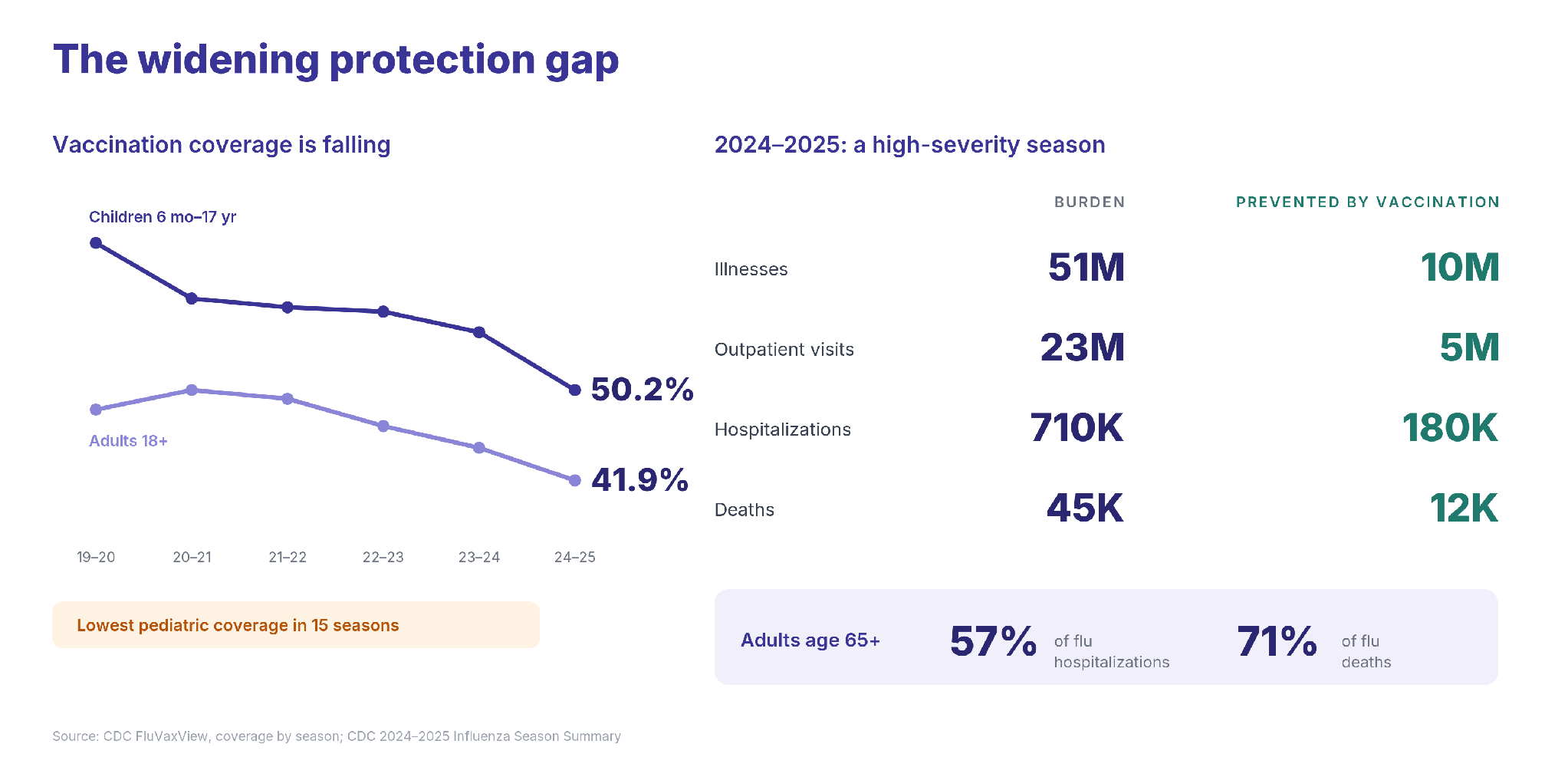
Last flu season told two concurrent stories.
Influenza vaccination coverage fell to 41.9% among adults and 50.2% among children, the lowest pediatric coverage recorded in the past 15 seasons.2
During that same 2024–2025 season, the CDC classified influenza severity as high, with an estimated 51 million illnesses, 23 million outpatient medical visits, 710,000 hospitalizations, and 45,000 deaths.3 Adults age 65 and older accounted for 57% of influenza-related hospitalizations and 71% of deaths.3
Even at diminished coverage levels, vaccination prevented an estimated 10 million illnesses, 5 million medical visits, 180,000 hospitalizations, and 12,000 deaths.³ These estimates show what is at stake. Influenza continues to cause substantial illness, hospitalization, and death, while fewer patients are receiving a vaccine that can reduce those outcomes.
For primary care, this is not simply a national trend. It is a care-delivery gap that can be addressed through trusted conversations, proactive outreach, and vaccination at routine points of care.
The decline extends across age groups and regions. Compared with the previous season, vaccination fell 5.9% among adults aged 65 and older and 4.1% among adults aged 50 to 64. Every pediatric age group also declined, including a 6.5-point drop among children aged 6 months to 4 years.
No jurisdiction improved adult or pediatric coverage, while 28 jurisdictions reported significant declines in each population.² The pattern points to a broader breakdown in vaccine confidence, clinician recommendation, and follow-through rather than an isolated regional problem.
Several forces are converging. Concerns about vaccine safety and effectiveness, amplified by post-pandemic misinformation, remain among the most commonly cited reasons for declining vaccination, and survey data suggest that patients without a trusted clinician are more likely to endorse vaccine myths.7
Routine touchpoints have also shifted: roughly half of adult flu vaccinations are now administered in pharmacies rather than medical offices,8 which improves access but removes the vaccine conversation from the exam room, and doses may remain unreconciled in the EHR when pharmacy, IIS, and EHR data do not flow reliably.
The practical translation for practices: vaccination coverage is being lost where access and follow-through break down. The losses concentrate in missed conversations at non-wellness visits, unreconciled outside doses, and high-risk patients who have quietly stopped coming in for preventive care.
Prevention is only part of the benefit. In a pooled analysis of adults hospitalized with influenza, those who had been vaccinated had 26% lower odds of ICU admission and 31% lower odds of death than unvaccinated adults.4 A useful framing at the point of care: the vaccine's job is not only to keep you from getting the flu. It is to keep the flu from putting you in the hospital.
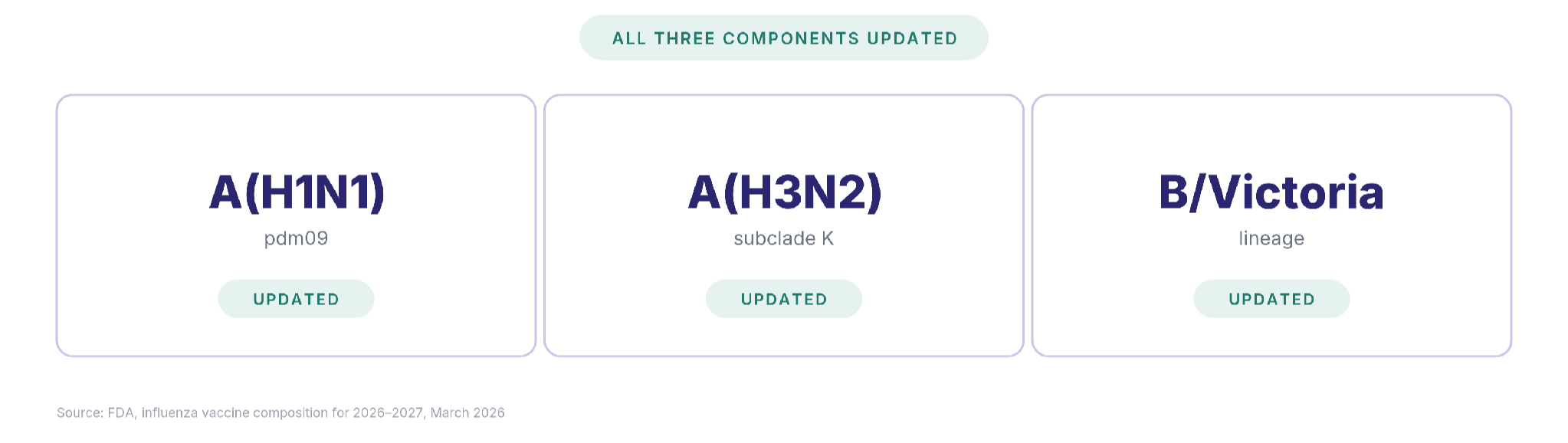
The 2026–2027 US vaccine are trivalent, targeting an A(H1N1)pdm09 virus, an A(H2N2) virus from subclade K, and a B/Victoria-lineage virus. The FDA updated all three components from last season.9
The baseline recommendation is universal: routine annual vaccination for everyone aged 6 months and older who does not have a contraindication.1 The clinical nuance lies in when, and for whom the timing shifts.
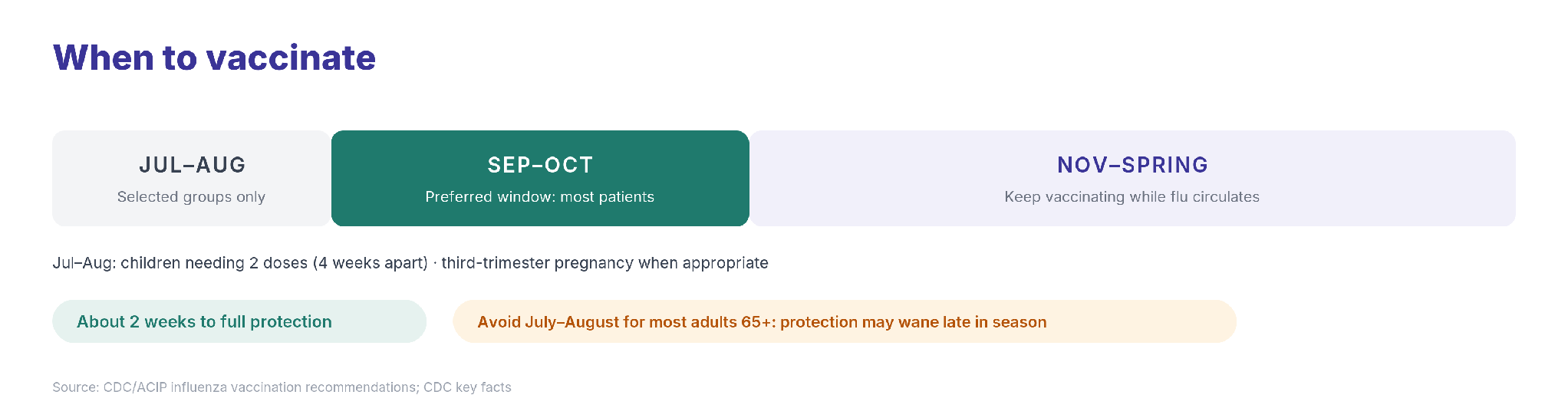
Protective antibodies take about two weeks to develop after vaccination.10 September and October remain the recommended window for most patients; vaccinating in July or August risks waning protection late in the season, particularly for adults aged 65 and older.1
The exceptions run in both directions. Children who need two doses should start early enough to accommodate the four-week interval between doses, and pregnant patients in the third trimester may reasonably be vaccinated in the summer months so their infants are born with passive protection.1 Late is still worthwhile: vaccination should continue as long as influenza viruses are circulating, often well into spring.1
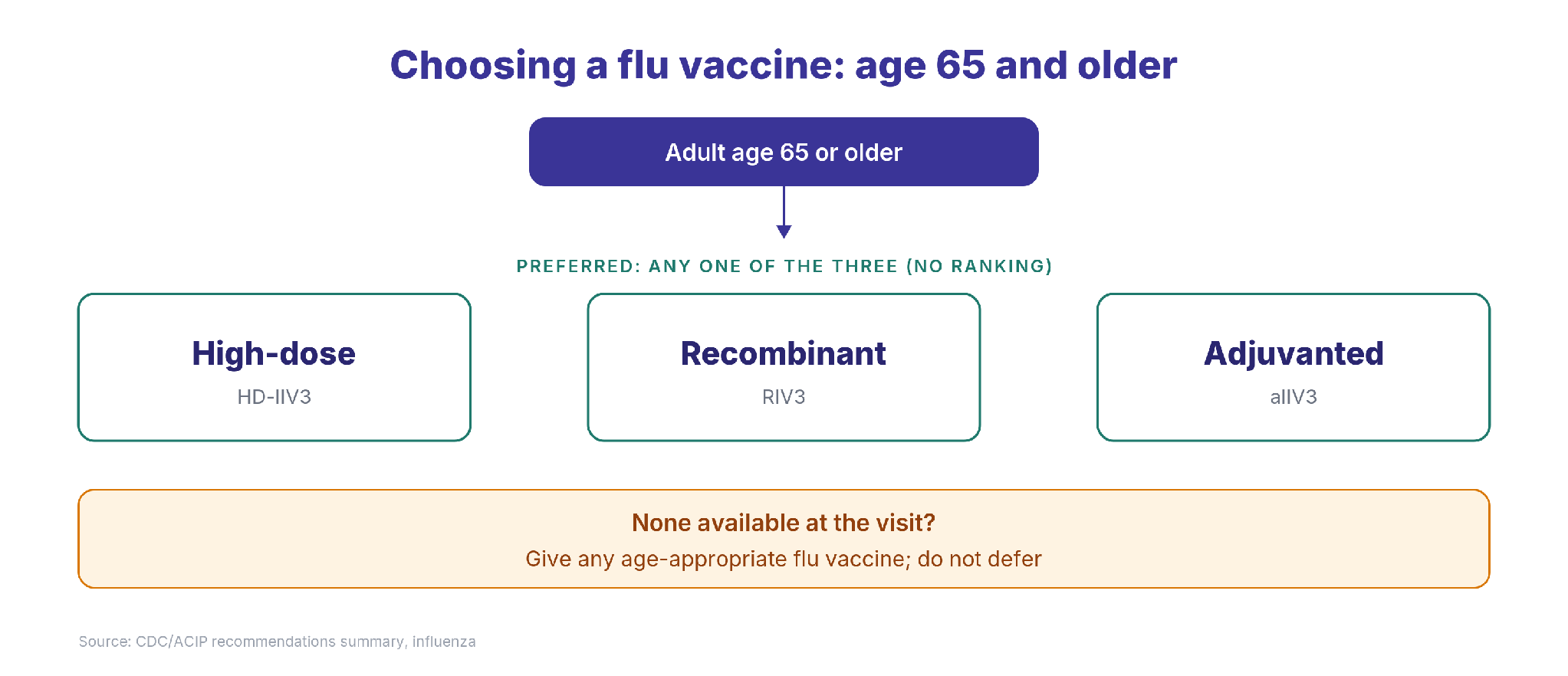
Immune response declines with age, and ACIP preferentially recommends one of three enhanced vaccines for adults aged 65 and older: high-dose inactivated (HD-IIV3), recombinant (RIV3), or adjuvanted inactivated (aIIV3). CDC expresses no preference among the three.1
Enhanced influenza vaccines produce a stronger immune response in older adults and have demonstrated greater protection against laboratory-confirmed influenza. Whether that stronger response consistently translates into fewer emergency visits, hospitalizations, readmissions, or deaths is less certain, and findings have varied by study, population, season, and endpoint.
In the pivotal randomized trial of nearly 32,000 adults age 65 and older, high-dose vaccines were 24.2% more effective than standard doses against laboratory-confirmed influenza.11
An earlier Veterans Health Administration study adds important context. The retrospective cohort included 165,225 community-dwelling veterans aged 65 and older during the 2010–2011 influenza season. Of these, 25,714 received a high-dose vaccine and 139,511 received a standard-dose vaccine. Hospitalization for influenza or pneumonia occurred in approximately 0.3% of both groups, with no significant overall difference in all-cause hospitalization or mortality.
A subgroup analysis suggested greater benefit among adults age 85 and older. Because the study was observational, lacked laboratory confirmation of influenza, and may not have captured care received outside the VA, that subgroup finding should be interpreted cautiously.12
GALFLU, a pragmatic randomized trial of more than 100,000 community-dwelling adults aged 65 to 79 in Spain, reported a 23.7% relative reduction in influenza or pneumonia hospitalization with high-dose vaccine. The absolute difference was small: a primary end-point event occurred in 0.26% of high-dose recipients versus 0.34% of standard-dose recipients over a season.13
In DANFLU-2, a pragmatic randomized trial of more than 330,000 older adults in Denmark, high-dose vaccination did not significantly reduce the primary combined outcome of influenza or pneumonia hospitalization. Influenza-specific hospitalizations, a component finding, were lower with high-dose vaccines. The trial should not be read as evidence of broad reductions in hospitalization or readmission.14
The practical distinction is important: a stronger immune response and improved protection against influenza do not guarantee a measurable reduction in every hospitalization or readmission endpoint. Enhanced vaccines remain the preferred option for adults age 65 and older, but clinicians should avoid overstating the magnitude or certainty of their advantage for broader healthcare utilization outcomes.
The operational takeaway is unchanged: stock and offer an enhanced product for patients age 65 and older, and if none are available at the moment of care, administer any age-appropriate vaccine rather than deferring.1
Most reasons patients, and sometimes clinicians, cite for withholding influenza vaccine are no longer supported by current guidance.
Pregnancy. Vaccination is recommended in any trimester, with any age-appropriate inactivated or recombinant vaccine. The live attenuated vaccine should not be used during pregnancy but may be used postpartum.1
Egg allergy. Since the 2023–2024 season, egg allergy of any severity requires no additional safety measures; any age-appropriate vaccine, egg-based or not, may be given.15
Previous vaccine reactions. A previous severe allergic reaction to an influenza vaccine requires product-specific review. Depending on the vaccine involved, another formulation may be contraindicated or may be administered as a precaution in an appropriate supervised setting. Consider allergy consultation when the responsible component or vaccine type is uncertain.15
Guillain-Barré syndrome. GBS within six weeks of a previous influenza vaccine is a precaution: generally avoid vaccination unless the patient’s risk of severe influenza complications outweighs it. A history of GBS unrelated to vaccination is not a contraindication.15
Acute illness. Moderate or severe acute illness warrants deferral until improvement. Mild illness does not.15
FluMist (LAIV).* A practical option for needle-averse patients aged 2 through 49 who would otherwise go unvaccinated, with eligibility rules that differ from injectable vaccines. Adults aged 18 through 49 may self-administer; for patients aged 2 through 17, the vaccine must be administered by a caregiver or healthcare professional.1,15
*This is not an exhaustive list; consult the full prescribing information and current ACIP guidance.1,15
Live-vaccine interval. When FluMist (LAIV) and another live vaccine are not administered on the same day, separate them by at least four weeks.6
"The flu shot gave me the flu." Injected inactivated and recombinant influenza vaccines contain no live influenza virus and cannot cause influenza; FluMist contains weakened, cold-adapted viruses that also do not cause influenza illness. A day of soreness, fatigue, or low-grade fever is an immune response, not an infection, and illness in the two weeks after vaccination reflects exposure before protection had developed.10
“I got the flu anyway, so it doesn’t work.” Acknowledge the frustration, then explain that preventing every infection is not the only goal. Among adults hospitalized with influenza, prior vaccination was associated with 26% lower odds of ICU admission and 31% lower odds of death.4 The vaccine may still help keep an infection from becoming a medical emergency.
“I’m healthy, I don’t need it.” Nearly 9 in 10 adults hospitalized with influenza have at least one underlying condition.16 Vaccination also helps reduce the likelihood of exposing family members and others at higher risk.
“It’s too late in the season.” It rarely is. Influenza often circulates into spring, and vaccination is recommended as long as viruses are circulating.1
Risk-stratify the panel before the season. Generate lists of adults aged 65 and older, patients with chronic cardiopulmonary, metabolic, renal, or hepatic disease, immunocompromised patients, pregnant patients, and children under 5. These are the groups for whom outreach yields the most prevented hospitalizations.1
Use standing orders and previsit planning. Eligible patients should be identified at check-in and vaccinated under an approved standing-order protocol, consistent with organizational policy and applicable scope-of-practice requirements; the decision point moves from the exam room to the workflow.
Treat every visit as a vaccination opportunity. Acute visits, chronic disease follow-ups, and Medicare wellness visits from September onward are all appropriate opportunities to offer influenza vaccination. For patients with COPD, diabetes, or heart failure, flu vaccination is chronic disease management.
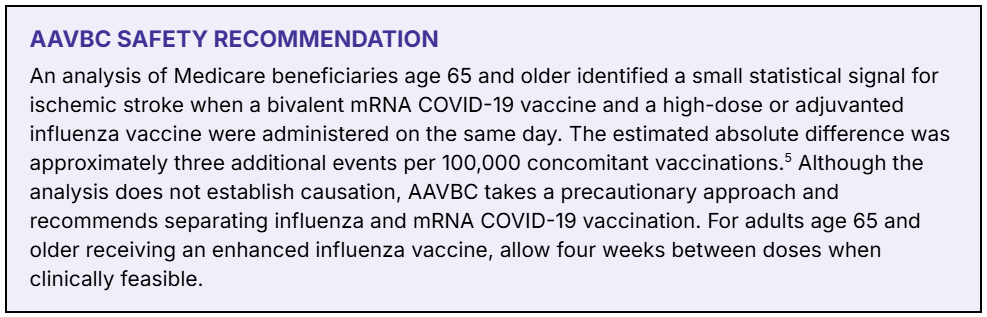
Plan vaccine spacing before the visit. When both influenza and mRNA COVID-19 vaccination are due, identify which vaccine should be administered first based on seasonal timing, patient risk, and previous vaccination history. Schedule the second vaccine approximately four weeks later and use an EHR reminder, outreach workflow, or follow-up appointment to reduce the risk of a missed dose.
Reach the patients who are not coming in. The steepest coverage losses are among patients with no recent touchpoint. Run unvaccinated high-risk lists, use calls and portal outreach, and coordinate with local pharmacies when that is the faster path.
Reconcile outside doses. Query the state immunization registry and document pharmacy-administered vaccines in the EHR, so outreach targets the right patients and the clinical record reflects vaccines already received.
Coverage and burden: flu vaccination coverage is declining while influenza continues to cause substantial illness, hospitalization, and death.2,3
Breakthrough disease: breakthrough infection does not mean the vaccine provided no benefit. Vaccinated patients hospitalized with influenza may have lower odds of ICU admission and death.4
High-dose nuance: enhanced vaccines produce stronger immune responses in older adults, but reductions in hospitalization, readmission, and mortality have not been consistent across studies. The VA study found no overall hospitalization advantage, with a possible benefit among adults age 85 and older.11-14
AAVBC safety approach: separate influenza and mRNA COVID-19 vaccination. For adults age 65 and older receiving a high-dose or adjuvanted flu vaccine, use a four-week interval and create a reliable follow-up plan.5
Close the operational gaps: risk-stratified outreach, standing orders, previsit planning, vaccination at every appropriate visit, and EHR reconciliation of outside doses. These five actions can help more patients receive timely protection and ensure the clinical record reflects vaccines already received.