





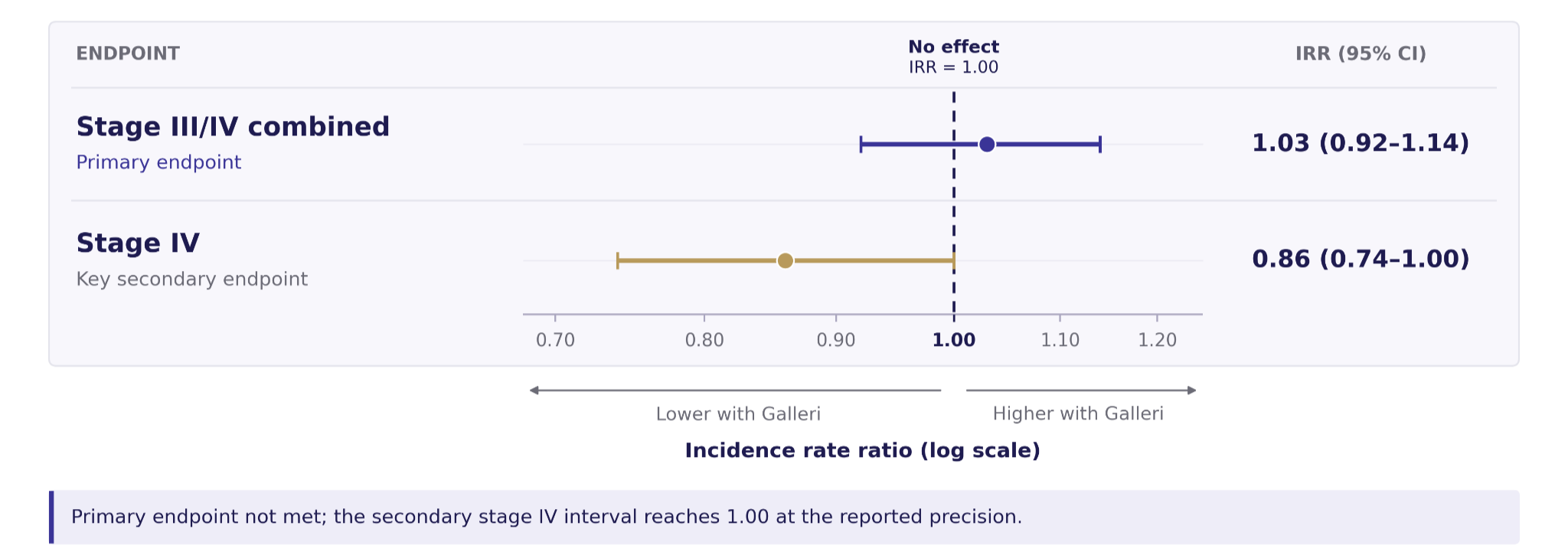
Multi-cancer early detection (MCED) blood tests aim to find cancer before symptoms appear, but are not always successful. The NHS-Galleri randomized trial of roughly 140,000 adults missed its primary endpoint: annual Galleri testing did not significantly reduce combined stage III and IV cancer diagnoses.1,2 Stage IV diagnoses fell while stage III diagnoses rose, so late-stage cancers were not reduced overall.1,3 An FDA advisory panel has voted in favor of the test, yet final FDA approval, Medicare coverage and guideline endorsement remain pending. This article reviews the trial's design, findings and examines the implications of false positives, false negatives and real-world use through a value-based care (VBC) lens – the right patients, for the right reasons, at the right time.
NHS-Galleri randomized 142,250 participants in England to annual Galleri testing plus usual care or usual care alone (Figure 1).1,4 Four findings matter most for anyone weighing the test's value:
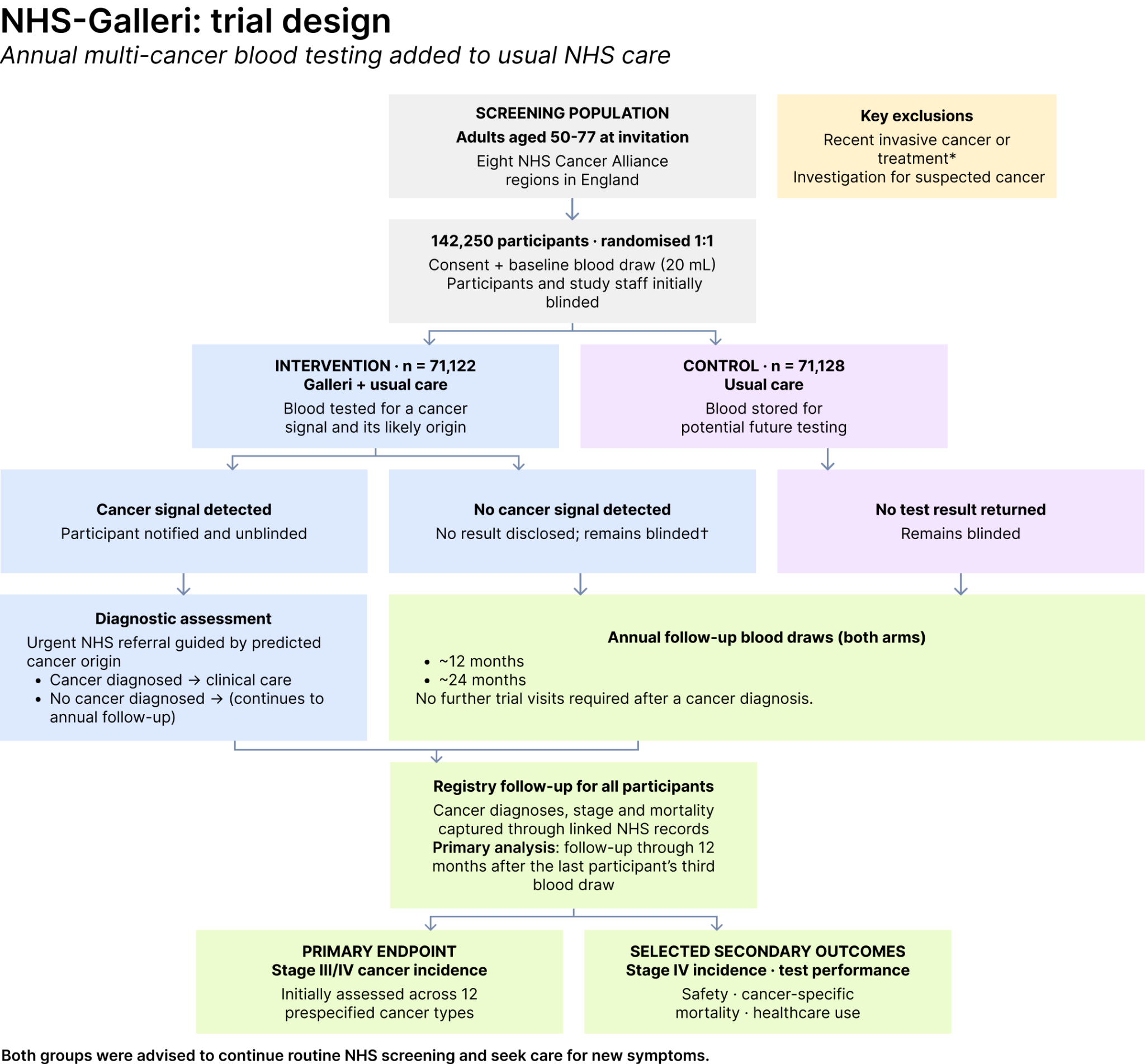
Galleria + usual care vs usual care - 12 prespecified cancer types - Three annual screening rounds
Cancer survival depends heavily on stage at diagnosis: in the United States, five-year relative survival is 92% for localized-stage disease, but only 35% for distant-stage disease.6 At the same time, about 58% of expected cancer deaths in 2026 are from cancer types with no USPSTF-recommended screening.6 MCED tests were developed to close that gap with a single blood draw that could, in theory, flag many cancer types at once.
The Galleri test works by scanning the blood for fragments of DNA shed by tumors. When the test detects a pattern associated with cancer, it reports a "cancer signal" and predicts where in the body the cancer may be, which guides diagnostic follow-up.4,6,10
NHS-Galleri was designed to test whether the approach translates into benefit. Unlike studies that only measure how well a test performs, it was a randomized trial asking a clinical-utility question: does adding annual Galleri testing to usual care reduce the number of people diagnosed at stage III or IV?4,5 A stage shift is a surrogate for the outcome that matters most, fewer cancer deaths, and the trial's primary objective was to test whether adding annual Galleri testing to NHS care lowers the incidence of stage III and IV cancers.1,9,11
The regulatory picture is encouraging but incomplete. On September 23, 2026, an FDA advisory panel voted in favor of Galleri, with majority votes in safety, effectiveness, and that the benefits outweigh the risks.8 However, an advisory vote is not an approval, and the final decision on premarket approval rests with the FDA.
Coverage is a separate hurdle. Galleri is not approved by the Centers for Medicare and Medicaid Services (CMS), so there is no established pathway for Medicare payment. Without it, access is largely out of pocket with a list price of $949 USD, which raises the equity concern that those who can afford the test are not necessarily those at greatest risk.
FDA put the question to its advisory panel directly: Does Galleri's performance support the proposed "early detection" indication?6,8 The panel generally expressed doubt that the term "early" was supported, while acknowledging some evidence that Galleri can detect cancers at early stages, and some panelists conditioned their effectiveness votes on removing the claim.8
The data explains the concern. Sensitivity for stage I disease was 13.6%,6 the trial's primary endpoint was missed,1 and stage III diagnoses rose while stage IV diagnoses fell.1,7
The test’s mechanism of detection offers some clues about this result. Advanced tumors shed more DNA and are therefore easier to detect, while small, early tumors shed little and are easier to miss.3,7 This explains the test’s central limitation and makes it unsurprising that Galleri struggles to identify early cancers.
For VBC, labels shape expectations.
If patients and clinicians believe a normal result means they are free of early cancer, or that a positive result reflects a meaningful head start, decisions will rest on a promise the evidence has not yet delivered. Precise language about what the test can and cannot do is part of delivering value.
Galleri has not been adopted as the standard of care for screening by the US Preventive Services Task Force (USPSTF), the American Cancer Society or any other major medical society. Those bodies set the benchmark for what health systems and payers consider appropriate, and none has yet endorsed MCED testing for routine use. FDA's own review notes that USPSTF screening recommendations currently cover only breast, cervical, colorectal, lung and prostate cancer, and that no FDA-authorized device is indicated for screening for multiple cancer types.6
Clinical use matters here as much as test performance.
Screening asymptomatic people is different from evaluating a patient with symptoms. In a screening population, most people tested do not have cancer, so even a small false positive rate produces many people who are told they may have it.12
Guidance on who should be tested (age, risk profile, family history), why, and how often is exactly what is missing. Without it, a test can be ordered widely and inconsistently, and the downstream costs scale with every additional test. The FDA panel stressed that Galleri should not replace established, guideline-recommended screening.8
Any screening test makes two kinds of errors, and each carries a value cost.
False positives can set off an unnecessary, invasive and expensive work-up. A cancer signal typically leads to imaging, specialist visits and sometimes biopsies, procedures the patient never needed if no cancer is present.10
Galleri has high specificity, but even a small false positive rate matters at population scale, and in the NHS-Galleri analysis reviewed by FDA, specificity was 99.74% but positive predictive value was 66.2%, meaning about one in three cancer signals did not lead to a cancer diagnosis within 12 months.6,7 In PATHFINDER 2, 47.8% of participants with a cancer signal, but no cancer diagnosis, underwent at least one invasive procedure, and 11.1% had a biopsy.6 These false alarms increase unnecessary anxiety, procedural risk and spending, and they strain diagnostic capacity that other patients also need.12
False negatives can create false reassurance. Since early tumors shed little DNA, the test misses most stage I cancers, as the 13.6% sensitivity shows.6,7 A patient with a small, early cancer may receive a negative result and then delay a symptom evaluation or skip a guideline-recommended screening such as a mammogram or colonoscopy. A test meant to add safety could, if misunderstood, subtract it, a risk FDA's own review also flags.6,12
VBC weighs both errors against the benefit. The calculation only works when the benefit is clear, and for Galleri, this is not yet the case.
NHS-Galleri is a landmark trial – the first large randomized study of a multi-cancer early detection test. It did not show what its primary endpoint required, a reduction in combined stage III and IV cancers, and its encouraging stage IV findings are partly offset by a rise in stage III diagnoses.1,3 The test performs best on cancers that are already advanced.7 Final FDA approval, CMS coverage and society guideline endorsement are all still outstanding.
For VBC, the practical takeaways are:
AAVBC awaits further clarity from the FDA, the American Cancer Society and other leading medical organizations on the right patients, the right reasons, and the right timing and cadence for these types of tests.