



On August 19, 2026, Merck and Moderna announced that adding a personalized mRNA therapy to Keytruda (pembrolizumab) improved recurrence-free and distant metastasis-free survival in a Phase 3 trial of patients whose melanoma had been completely removed by surgery. According to information from company representatives, the investigational therapy, intismeran autogene, is tailored to the unique mutations in each patient’s tumor. It is the first Phase 3 success for an individualized neoantigen therapy and for mRNA in oncology.1
The response was immediate and enormous. Moderna's market value rose roughly $44 billion in a single session. BioNTech, which reported nothing that day, rose 22% on the strength of owning a similar product.2
The more useful question for clinicians is narrower: what does the announcement actually establish, and what do you need to know?
INTerpath-001 (NCT05933577) enrolled 1,137 patients with completely resected, high-risk stage IIB–IV cutaneous melanoma and no prior systemic therapy.1,3,4 Patients were randomized 2:1 in a double-blind, placebo- and active-comparator-controlled design. The control arm received placebo injections plus pembrolizumab, and neither patients nor investigators knew the assignment. Treatment ran for approximately a year: intismeran 1 mg intramuscularly every three weeks for up to nine doses, alongside pembrolizumab 400 mg every six weeks.3,4
The randomized, double-blind design strengthens confidence in the comparison. The use of placebo injections alongside active pembrolizumab reduced the likelihood that knowledge of treatment assignment influenced surveillance or interpretation. Important questions remain, but the study was designed to provide a rigorous comparison with an established adjuvant therapy.5
The therapy itself works from the patient's own tumor. After resection, tissue and blood are sequenced, an algorithm selects up to 34 mutations unique to that cancer and matched to the patient's HLA type, and those targets are encoded into a bespoke mRNA product delivered in lipid nanoparticles. The immune system is trained to recognize any remaining cells carrying them.6,7
The release stated that the trial met its primary endpoint, recurrence-free survival, and its key secondary endpoint, distant metastasis-free survival, describing the results as statistically significant and clinically meaningful. No supporting data was provided.
The release did not include the hazard ratio, the confidence interval, the p-value, event counts by treatment arm, median follow-up duration, the absolute difference between arms, or subgroup analyses by disease stage.
Moderna announced on September 21 that the INTerpath-001 melanoma data will be presented in the Presidential Symposium at the ESMO Congress 2026 in Madrid, on Saturday, October 24, 2026 at 4:30 PM CEST.8
The endpoints were met, but this remains an early look at surrogate measures, with the supporting figures still unpublished. Three factors must be considered
1. Interim analysis
The analysis was conducted at a pre-specified checkpoint before the trial completed follow-up, and interim analyses of time-to-event endpoints characteristically overestimate effect size relative to the final analysis. This is a recognized statistical property of interim analysis, but it means the reported effect estimates may shift as additional events accrue and follow-up matures. The final magnitude and durability of benefit cannot be established until the complete results are available.
2. Surrogate endpoints, not overall survival
Recurrence-free survival and distant metastasis-free survival are clinically relevant endpoints that capture outcomes patients care about, including whether melanoma returns or spreads after surgical resection, but they are not equivalent to overall survival. INTerpath-001 has not yet established whether intismeran helps patients live longer, and its overall-survival data remain immature.
A full interpretation of the benefit will depend on the absolute reduction in recurrence, the duration of that benefit, safety findings, quality-of-life outcomes, and longer follow-up.
3. Sponsor-reported topline data only
Sponsor funding and involvement are standard features of commercial drug development and do not by themselves indicate bias, but the only information available at this stage is a topline announcement from the companies developing the therapy. Formal presentation, detailed statistical analysis, and peer review are still needed before the magnitude, consistency, and clinical relevance of the reported benefit can be fully assessed.
“It is an Individualized Neoantigen Therapy, not a vaccine.”
Intismeran does not prevent melanoma in healthy individuals, the way a traditional vaccine works. It is an individualized therapy created from a patient's own tumor and given after surgery to help the immune system recognize remaining cancer cells and reduce the risk of recurrence.
“The size of the benefit is not yet public.”
A large trial called INTerpath-001 found that adding intismeran autogene, a personalized mRNA therapy made from the patient's own tumor, to pembrolizumab (Keytruda) reduced the risk of melanoma coming back after surgery.⁶ The exact size of that benefit has not been released yet.⁶ Full results are expected in October at a medical conference.⁸
One of the most important features of this result has received comparatively little attention: intismeran was not tested against placebo alone. It was added to pembrolizumab, an established adjuvant therapy whose approval was supported by improvements in recurrence-free survival rather than a demonstrated overall-survival benefit.
In KEYNOTE-716, which enrolled patients with completely resected stage IIB or IIC melanoma, estimated 36-month recurrence-free survival was 76.2% with pembrolizumab and 63.4% with placebo (HR, 0.62; 95% CI, 0.49–0.79). Estimated distant metastasis-free survival was 84.4% and 74.7%, respectively. These results represent meaningful reductions in the risk of recurrence and distant metastasis, although an overall-survival benefit has not been established in this setting.
Pembrolizumab formed the control regimen in INTerpath-001. Intismeran was therefore evaluated as an addition to active therapy, with recurrence-free survival as the primary endpoint and distant metastasis-free survival as a key secondary endpoint. Regulatory review will require weighing intismeran's added value: absolute risk reduction, safety, treatment burden, manufacturing reliability, turnaround time, and quality of life.
Delaying recurrence is a clinical benefit, independent of any overall-survival effect, but the two are not interchangeable. Outcomes models should state clearly how recurrence-based gains translate into assumptions about survival, quality of life, and healthcare use.
The immediate limitation is that the information required to quantify the incremental benefit remains unavailable. Without event counts, absolute risk differences, duration of follow-up, subgroup findings, and complete safety results, the number needed to treat cannot be calculated and the balance between added benefit and added burden cannot yet be assessed.
A complete assessment will require hazard ratios with confidence intervals for both endpoints, absolute event counts, median follow-up, stage-specific findings, complete safety and discontinuation data, quality-of-life results, manufacturing success rates, turnaround time, and anticipated access requirements. These findings will determine the magnitude of benefit, the patients most likely to benefit, and the practical demands of incorporating the therapy into care.
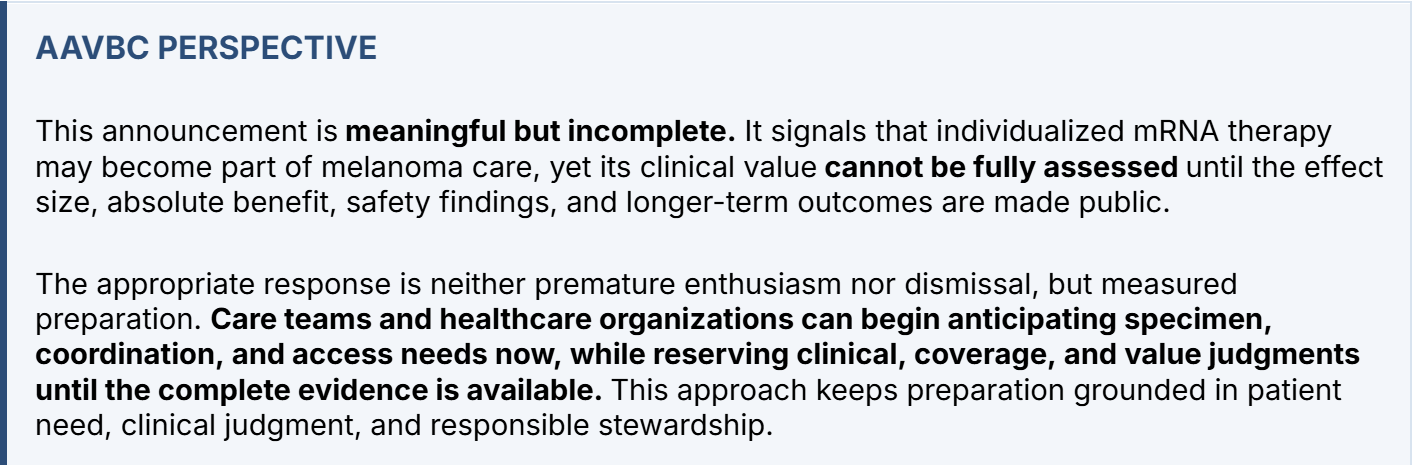
Individualized mRNA therapy may be approaching clinical use, but its magnitude and implications cannot yet be determined.
The appropriate response is to recognize the importance of the milestone, prepare for the potential care pathway, and reserve firm conclusions until the effect estimates, safety findings, subgroup results, and longer-term outcomes are public.
Enthusiasm and scientific rigor can, and should, coexist.